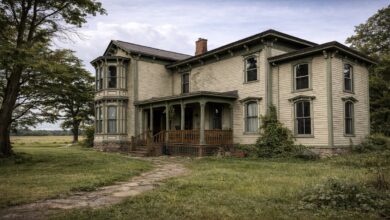
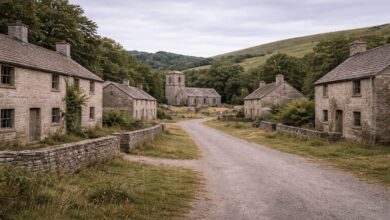
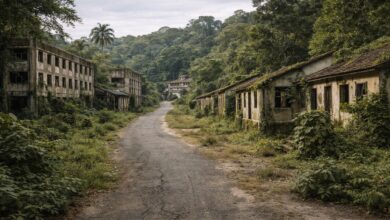
At a bend of the Alabama River, south of Selma, the remains of Cahaba sit low against the floodplain. Brick foundations surface through grass. Cemetery plots emerge and recede with the seasons. Streets that once carried political ambition now dissolve into wetlands. Cahaba was not a town that failed quietly. It was a state capital by design, abandoned by consequence, and gradually overtaken by forces its founders underestimated.
What distinguishes Cahaba is not sudden destruction but accumulation. Flooding, disease, and geographic miscalculation worked together over decades, eroding confidence until the city’s political role and population slipped away. The land did not reclaim Cahaba all at once. It absorbed it patiently.
A capital chosen for promise
Cahaba was selected as Alabama’s first permanent state capital in the early nineteenth century. Its location at the confluence of rivers promised trade, transportation, and regional balance. Lawmakers envisioned a planned city that would anchor the young state.
Public buildings were erected. Streets were laid out. Residential blocks followed civic logic.
Cahaba was built to represent stability and governance. Similar human responses to silence and environment appear in former Town of Mologa.
Geography as quiet adversary
The same river that offered access also carried risk. Cahaba sat on low ground vulnerable to seasonal flooding. Water regularly invaded streets and buildings.
Flooding was not catastrophic in isolation. It was persistent. Each inundation weakened infrastructure and confidence.
The city functioned, but never comfortably.
Disease shaped by environment
Stagnant water and humid conditions contributed to outbreaks of illness, including malaria and yellow fever. Disease did not strike once. It returned repeatedly.
These conditions discouraged settlement and strained public life. Officials and residents alike struggled with the health implications of place.
The environment shaped daily risk.
Political retreat without collapse
After only a few years, the state government relocated the capital. The move was administrative, not dramatic. Cahaba did not burn or fall.
It simply lost relevance.
When political authority left, investment followed.
A town without its function
Cahaba continued as a town after losing capital status, but its defining role was gone. Commerce slowed. Population declined. Maintenance faltered.
The town became ordinary without the resources to sustain itself.
Ordinariness was not enough to overcome geography.
The Civil War and layered disruption
During the Civil War, Cahaba briefly reentered history as a prison site. This role added another layer of use, then ended.
After the war, the town never fully recovered. Reconstruction bypassed it.
Cahaba accumulated histories without continuity.
Abandonment through attrition
Residents left gradually. Homes were vacated. Public buildings deteriorated. Cemeteries filled, then flooded.
No single moment marks Cahaba’s end. It faded through repetition of difficulty.
Attrition replaced decision.
Ruins shaped by water
Today, remnants of Cahaba rise and fall with the river. Brick walls appear after droughts. Graves surface and sink again.
Water does not erase evenly. It edits.
This cyclical exposure gives the site a sense of unsettled memory.
Why unease is often reported
Visitors frequently describe unease at Cahaba. This response is not rooted in legend.
It arises from instability. Ground that appears solid shifts seasonally. Boundaries between land and water blur.
Uncertainty is environmental rather than narrative.
Cemeteries without permanence
Burial grounds at Cahaba are particularly affected by flooding. Markers tilt. Coffins have surfaced during extreme water events.
Death here was not granted permanence.
This lack of finality disturbs expectations of rest.
Absence without spectacle
Cahaba does not present dramatic ruins. Its remains are low, fragmented, and dispersed.
The lack of spectacle forces attention to process rather than event.
Process is harder to romanticize.
Comparison with other abandoned capitals
Few former capitals were abandoned so completely. Most evolved into secondary cities.
Cahaba’s failure was environmental as much as political.
Place, not policy, dictated outcome.
Memory shaped by misjudgement
Cahaba stands as a record of early American optimism colliding with landscape reality. Planning assumed control over environment.
The environment disagreed.
This tension defines the site.
Ethical restraint in interpretation
Cahaba is often framed as mysterious. In truth, its story is documented.
Responsible interpretation centers on human decision and environmental consequence, not speculation.
The lesson is practical, not supernatural.
Time as collaborator
Time did not destroy Cahaba violently. It collaborated with water, disease, and neglect.
Decay was incremental.
Incremental loss is harder to confront.
A place that resists closure
Because Cahaba resurfaces repeatedly, it never fully disappears. Each exposure interrupts forgetting.
The town refuses a clean ending.
It persists as fragment.
Why Cahaba still matters
Cahaba matters because it illustrates how governance, health, and geography intersect. Ambition alone could not secure permanence.
The site reminds observers that place selection carries long term consequences.
History is grounded, literally.
Between river and ruin
The Alabama River continues its course, indifferent to what once stood beside it. Cahaba’s remains sit within its rhythm.
Human plans existed briefly. The river remains.
This contrast anchors reflection.
Enduring Perspective
Cahaba endures as a former state capital overtaken by river flooding and disease, where political ambition met environmental reality. Its power lies not in spectacle, but in repetition. Floods returned. Illness returned. Confidence eroded.
The town was not destroyed. It was worn away. Today, its ruins surface and vanish with the river’s level, reminding observers that some places are undone not by singular events, but by conditions that persist.
On the Alabama floodplain, Cahaba stands as evidence that history does not always collapse dramatically. Sometimes it simply recedes, leaving traces that return when the water allows. Related reflections on memory and perception can also be found in remains of Rhyolite.
Horizon Report documents places shaped by memory, infrastructure, and human decisions. Our editorial approach focuses on what remains physically visible, how abandonment unfolds over time, and how interpretation is clearly separated from observable evidence.
For readers seeking deeper context, the following background articles explore how ghost towns emerge, why communities are left behind, and why preservation matters in understanding collective history.
- Abandonment And Ghost Towns
- What Is A Ghost Town
- Why Towns Are Abandoned
- Preserving Abandoned Places
Editorial transparency matters. Observations are grounded in site layout, materials, remaining structures, and documented timelines where available. Interpretive layers are presented as interpretation, not assertion.
Careful readers often notice details worth refining. Thoughtful feedback helps ensure accuracy, clarity, and long term editorial integrity.